API and webhooks
A REST API with an OpenAPI spec, and signed webhooks whenever something happens to a video.
import { Crumbcast } from "crumbcast"; const crumbcast = new Crumbcast({ token: process.env.CRUMBCAST_TOKEN, baseUrl: "https://your-crumbcast",}); const video = await crumbcast.videos.getVideo({ id: videoId,}); // Refused: a CrumbcastError, with the API's reasonawait crumbcast.videos.updateVideo({ id: videoId, videoUpdateRequest: { title: "Launch day" },});import os from crumbcast import Crumbcast crumbcast = Crumbcast( token=os.environ["CRUMBCAST_TOKEN"], base_url="https://your-crumbcast",) video = crumbcast.videos.get_video(video_id) # Refused: a CrumbcastError, with the API's reasoncrumbcast.videos.update_video( video_id, body={"title": "Launch day"},)use Crumbcast\Crumbcast; $crumbcast = new Crumbcast( token: getenv('CRUMBCAST_TOKEN'), baseUrl: 'https://your-crumbcast',); $video = $crumbcast->videos->getVideo($videoId); // Refused: a CrumbcastException, with the API's reason$crumbcast->videos->updateVideo($videoId, [ 'title' => 'Launch day',]);const api = "https://your-crumbcast/api/v1"; // A project's API token, from its settings: it goes with every requestconst headers = { Authorization: `Bearer ${process.env.CRUMBCAST_TOKEN}` }; const video = await fetch(`${api}/videos/${videoId}/`, { headers }) .then((response) => response.json());What's included
- A REST API with an OpenAPI specEverything the dashboard does, from your own code, with SDKs for TypeScript, Python and PHP, or a client generated from the spec.
- Signed webhooksA signed request whenever something happens to a video or a live stream.
- Playback your backend signsShort-lived tokens decide who may watch, checked on every request.
- Embeds controlled with postMessageDrive the player from your page and react to its events.
From token to product
Make a token
One for each thing that uses it, with the lowest role that does the job.
Call the API
Use the SDK for TypeScript, Python or PHP, generate a client from the OpenAPI spec, or call it directly.
Hear what happens
Signed webhooks tell your backend when a video plays, fails or goes.
The specifics
- Spec
- /api/v1/openapi.public.json
- Sign in
- A project's API token, as a Bearer header
- Roles
- viewer, editor or admin
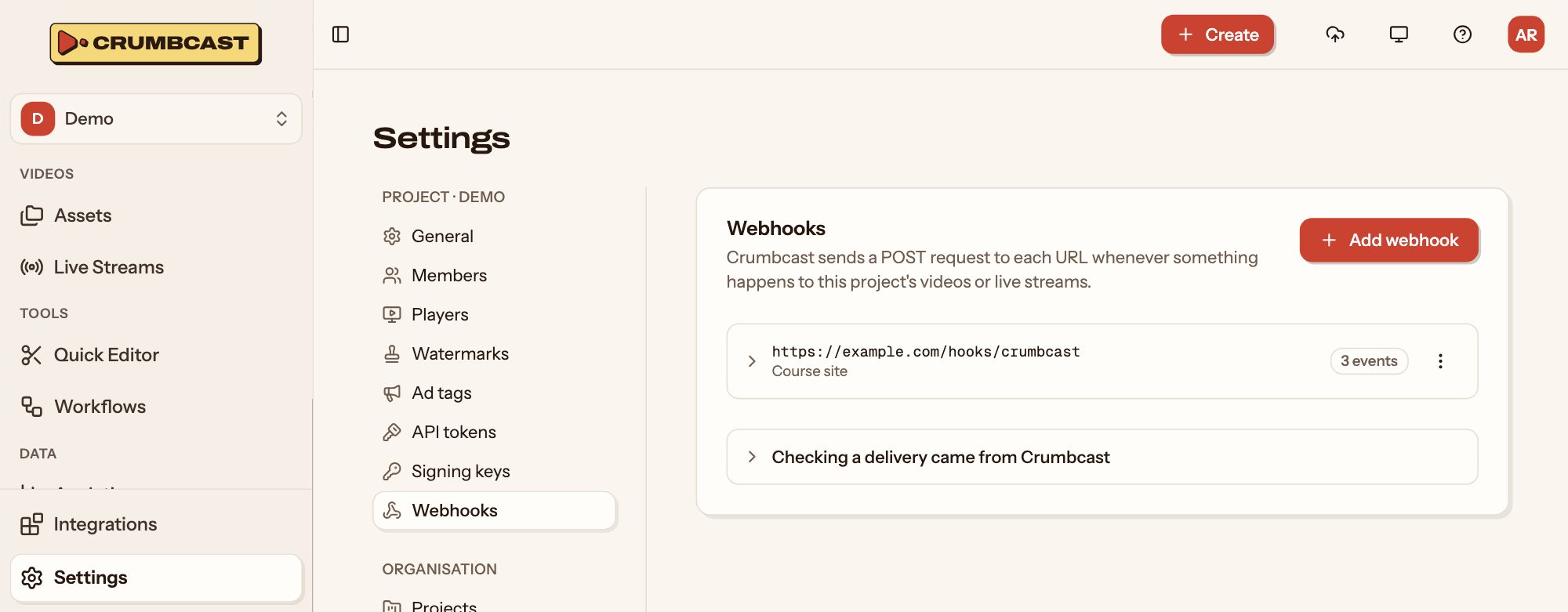
- Webhooks
- Signed, and tried again for about 42 hours
- Live updates
- A WebSocket for a project's videos
- AI agents
- An MCP server, held to the same rules as tokens
import { verifyWebhook } from "crumbcast"; // A Next.js route handler; with Express, use express.raw()export async function POST(request) { // Throws unless signed with your secret, in the last 5 min const event = await verifyWebhook( await request.text(), request.headers.get("Crumbcast-Signature"), process.env.CRUMBCAST_WEBHOOK_SECRET, ); if (event.type === "video.ready") { await publish(event.data.video.id); } return new Response(null, { status: 204 });}On every plan
All of it comes with every plan, Free included.
Who it's for
Questions
What can't a token do?
It works in its own project only, and can't manage members, tokens, your account, the organisation, its storages or billing.
What happens when my plan doesn't have something?
The API answers 402 and says which plan has it, before anything is uploaded.
What if my server misses a webhook?
It's tried again up to 7 times over about 42 hours, until it's taken, and each delivery's answer is listed.
More products
Your first video is one drop away
Start on the Free plan, and move up when you need more.
Free includes 120 stored minutes and is never billed.